

Why Local Florist Arrangements Cost More: A 2026 Guide
Table of Contents
- The Real Price of Local Florist Arrangements
- 7 Reasons Local Florist Arrangements Cost More
- Why Are Bouquets So Expensive? A Cost Breakdown
- Local Florist vs Online Flower Chains
- Seasonal Flowers and Pricing: When to Buy
- How to Save Money on Flowers Without Losing Quality
- How to Tell If an Arrangement Is Fairly Priced
- Frequently Asked Questions
Last Updated: October 18, 2026
The Real Price of Local Florist Arrangements
A $90 bouquet is not $90 of flowers. That is the first thing to understand about why local florist arrangements cost more than the mass-produced bunches you see online. At Berwick Flowers, we build every bouquet by hand in our studio, and we would rather show you the maths than ask you to take it on faith.
Here is what most price guides get wrong: they compare a florist's bouquet to a supermarket bunch as if they were the same product. They are not. One is designed, conditioned, and delivered fresh. The other is a stem count on a shelf.
Below, we break down where your money actually goes, why bouquets cost what they do, and how to tell a fair price from an inflated one.
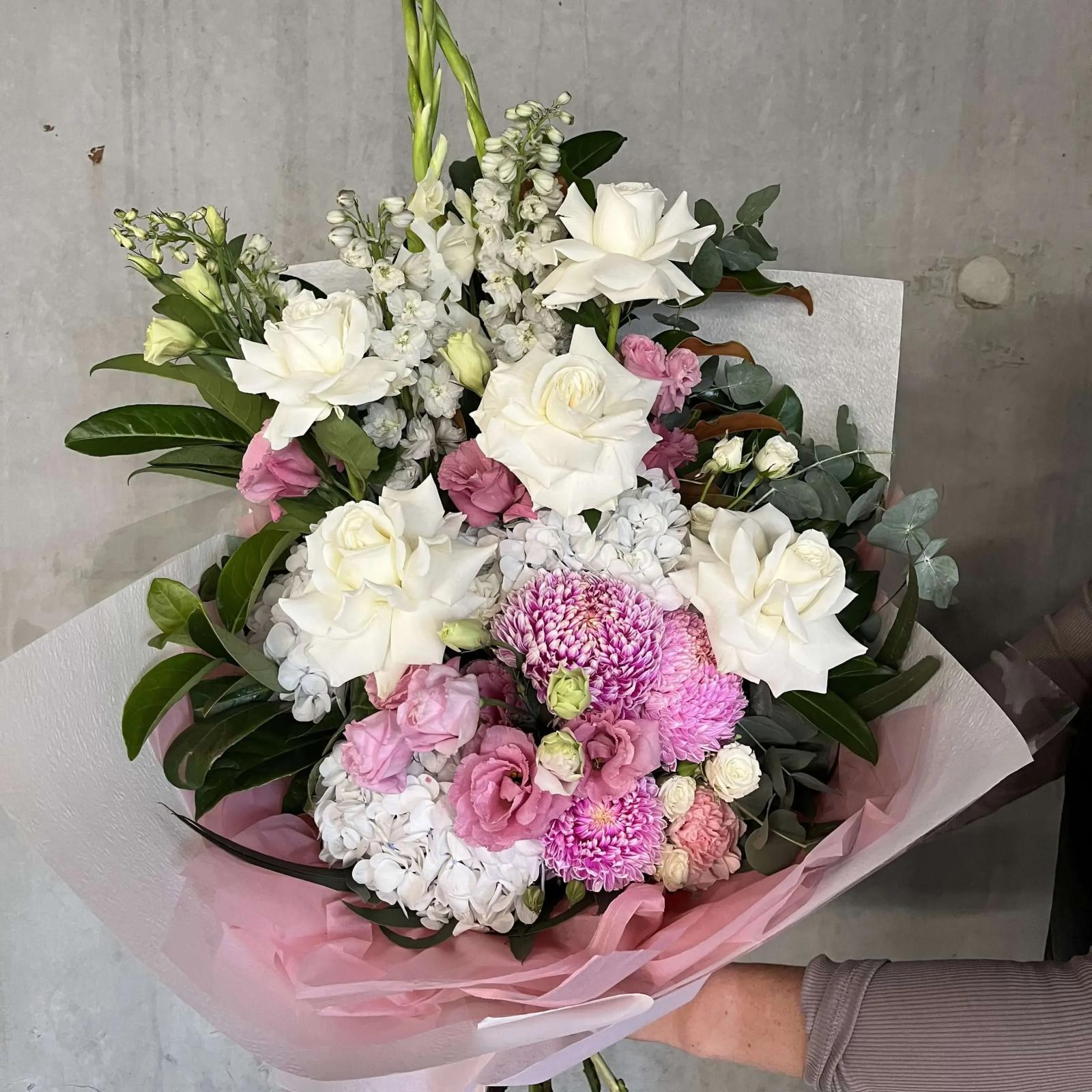
What a $90 bouquet actually pays for
Think of a $90 bouquet as four separate costs stacked together:
- The flowers themselves, bought at the morning market
- The studio: rent, power, water, refrigeration
- The labour: conditioning, design, wrapping, delivery
- The waste: stems that never make it to a customer
Most people assume the flowers are the biggest line. In practice, the studio and the labour often cost more than the blooms. That gap is the whole story behind why local florist arrangements cost more than a warehouse bundle.
7 Reasons Local Florist Arrangements Cost More
Local florist arrangements cost more because they carry costs a warehouse does not: a real shopfront, hand design, same-day delivery, and fresh stock bought in small volumes. Seven factors drive the difference.
Shop overheads: rent, utilities and wages
A shopfront costs money every day, whether or not anyone walks in. Rent, power for cool rooms, water, insurance, and staff wages all sit in the price of every stem you buy. An online warehouse spreads those costs across thousands of orders a week. A local shop spreads them across a neighbourhood.
Handling, storage and spoilage
Fresh flowers are perishable stock. They need cool storage, clean water, and daily attention. Some stems wilt before they sell. That loss is real, and it has to be covered somewhere. A florist who buys carefully still writes off stock every week.
Florist labour and design expertise
Design is skilled work. A trained florist knows how to condition stems, balance colour, and build a shape that holds. That expertise took years to learn. You are paying for the eye, not just the flowers.
Why Are Bouquets So Expensive? A Cost Breakdown
Bouquets are expensive because the price reflects the whole chain, from the flower farm to your front door. Most price guides stop at 'overheads and labour' without showing how those costs stack up. Here is a worked example for a $90 hand-tied bouquet, using typical proportions a local shop might see.
| Cost component | What it covers | Typical share of a $90 bouquet |
|---|---|---|
| Wholesale flowers and foliage | Stems bought at market, graded and bunched; includes some loss at the market | About $30-$35 |
| Shop overheads | Rent, power for cool room, water, insurance, POS and card fees | About $15-$20 |
| Florist labour | Conditioning, design, wrapping, card writing, order admin | About $20-$25 |
| Delivery | Local courier, fuel, time window, failed-delivery risk | About $10-$15 (if included) |
| Spoilage and waste | Stems lost to wilting, damage, or unsold stock | About $5-$10 |
| Profit | What the shop keeps to reinvest and pay itself | A few dollars |
A few things stand out when you lay it out like this. First, the flowers are rarely more than about a third of the price. Second, the shop's profit is thin, often less than the cost of the card and wrapping combined. Third, delivery is not a rounding error; if it is bundled into the headline price, it is doing real work.
The exact split shifts with the season and the flower varieties you choose. Imported stems in winter can push the wholesale line higher; a peak-date delivery can push the delivery line higher. But the pattern holds: no single line is huge, and the total adds up.
Local Florist vs Online Flower Chains
A local florist and an online flower chain sell different things. The chain sells a stem count shipped from a distant warehouse, often assembled by a relay florist you never speak to. The local florist sells a design made that morning, often delivered the same day by the person who made it.
That difference shows up in three places:
- Freshness: local stock is bought in small volumes and turned over fast
- Design: a florist builds to the occasion, not to a photo on a screen
- Accountability: you can call the person who made your bouquet
But the fair test is not the headline price. It is a like-for-like comparison. Here is how to run one before you order from either channel.
Compare these five things, not just the price
- Stem count and arrangement size. A $70 online bouquet and a $90 local bouquet are not comparable if one has 12 stems and the other has 20. Ask for the stem count and the approximate dimensions (height and width) of the finished arrangement.
- Flower varieties. A bouquet built mostly from filler and a single focal flower costs less to make than one with several focal blooms. Ask what the focal flowers are, not just the colour palette.
- Substitutions. Online chains often reserve the right to substitute flowers without notice. A local florist may also substitute, but you can usually ask what will change and why. If substitutions are likely, ask whether the value is maintained.
- Delivery and service fees. Online prices often exclude delivery, a service fee, or a relay fee paid to the fulfilling florist. Add every line before you compare. A $65 bouquet with a $20 delivery fee and a $5 service fee is a $90 bouquet.
- What is included. Card, vase, wrapping, and care instructions may be extras online and standard locally, or the reverse. Check the inclusions, not just the flowers.
A worked comparison
Suppose an online chain advertises a bouquet for $65 plus $15 delivery. A local shop quotes $90 delivered. On paper the online option is $10 cheaper. But if the online bouquet has 10 stems and the local one has 16, the local price per stem is lower. If the online order also carries a $5 service fee, the gap disappears entirely. And if the online bouquet arrives with substitutions you did not choose, the value comparison shifts again.
The point is not that local is always cheaper. It is that headline price alone tells you very little. Compare stem count, size, varieties, fees, and inclusions, and the value usually becomes clear.
Seasonal Flowers and Pricing: When to Buy
Seasonal flowers cost less because they are growing locally and in abundance. When a flower is out of season, it has to be sourced from further away, and that transport cost lands on your bouquet.
Buy with the season and you get more for your money:
- Spring: tulips, ranunculus, and sweet peas are at their best
- Summer: roses, sunflowers, and dahlias are plentiful
- Autumn: dahlias and chrysanthemums hold strong
- Winter: natives, proteas, and hardy foliage carry the season
Ask your florist what is looking good this week. A good shop will steer you toward what is fresh and fairly priced, not what is hardest to source.
How to Save Money on Flowers Without Losing Quality
You can save on flowers without settling for a tired bunch. The trick is to work with the season and let the florist choose.
Here is how we would do it:
- Buy in season. Seasonal stems cost less and last longer.
- Let the florist pick. A florist's choice bouquet uses the best of that morning's market, which often means better value than a fixed recipe. Our Violeta's Choice Bouquet works exactly this way.
- Choose a smaller size. A Classic size in a good design beats a large, thin one.
- Skip the extras. Add a card, not a balloon, if budget is tight.
- Order for the occasion, not the photo. A birthday or anniversary arrangement built for the moment beats a generic bundle, which is why our birthday flowers and anniversary flowers are designed around the occasion rather than a one-size-fits-all recipe.
How to Tell If an Arrangement Is Fairly Priced
A fairly priced arrangement shows its value in three ways: fresh stock, a balanced design, and a clear stem count. If a bouquet looks thin for the money, it probably is.

Use this checklist before you buy:
- Are the blooms fresh, with firm petals and clean stems?
- Does the design have focal flowers, not just filler?
- Is the stem count reasonable for the size?
- Does the price include delivery, or is that added later?
- Can the florist tell you what is in season and why?
A fair price is not the lowest price. It is the price that matches what arrives at the door. Our Floral Hug Luxury Flower Vase is a good example of a piece where the premium blooms and the glass vessel are visible in the price.

Frequently Asked Questions
Why do local florists charge more than online flower chains?
Online chains often route orders through a network and take a commission before a local florist fills the job, so less of your money reaches the blooms. A local florist arrangements price includes fresh market stock, hand design in the studio, and delivery by their own courier. That means fewer middleman costs, less handling between purchase and delivery, and better freshness on arrival. You are paying for the flowers and the hands that build them, not for a platform sitting in between.
Are seasonal flowers cheaper than out-of-season flowers?
Yes, usually. When a flower is in season locally, supply is high and wholesale prices drop, so a bouquet built around seasonal blooms gives you more stems for the same spend. Out-of-season varieties have to be sourced, transported and stored longer, which adds to flower costs. Ask your florist what is looking best that week. A good local florist will build around what is fresh and abundant rather than forcing a fixed list.
How can I save money on flowers without getting a smaller bouquet?
Choose a florist's choice bouquet, which lets the designer work with the best value blooms from that morning's market. Violeta's Choice Bouquet at $90 is hand tied in the studio from seasonal stock, so you get more flowers for the price than a fixed recipe. Order for midweek delivery, collect in store where possible, and skip premium imported varieties. Substitutions within the same palette keep the look without the out-of-season cost.
Does a florist's delivery fee include the cost of the flowers?
No. Delivery is a separate service covering the courier, fuel, time and careful handling in transit. The arrangement price covers the blooms, foliage, wrapping and the design labour in the studio. Some online platforms bury a markup inside the product price and then add delivery on top, which makes the total harder to read. A local florist will usually show the arrangement price and the delivery fee as two clear lines so you know what you are paying for.
Fresh flowers carry real costs, and a fair price reflects them. If you want arrangements built by hand with seasonal blooms and delivered the same day across the region, Berwick Flowers can help. Our family-run studio handcrafts every bouquet, uses fresh seasonal flowers, and offers reliable same-day delivery. Order online and send something that actually looks like the photo.


